Research evidence guide
5-Amino-1MQ research starts with the complete chemical identity.
A cited guide to the quinolinium NNMT inhibitor, cation-versus-salt distinctions, assay evidence and current non-clinical research formats.
Evidence snapshot5-amino-1MQ is a small-molecule quinolinium compound—not a peptide. A shorthand product name does not identify its counterion, formula-weight basis or seller lot.[1][2]
Compare current prices and formats.
For qualified non-clinical research buyers. Not for human or veterinary use.
Disclosure: We may earn a commission from purchases made through our links.
It is a small molecule, not a peptide
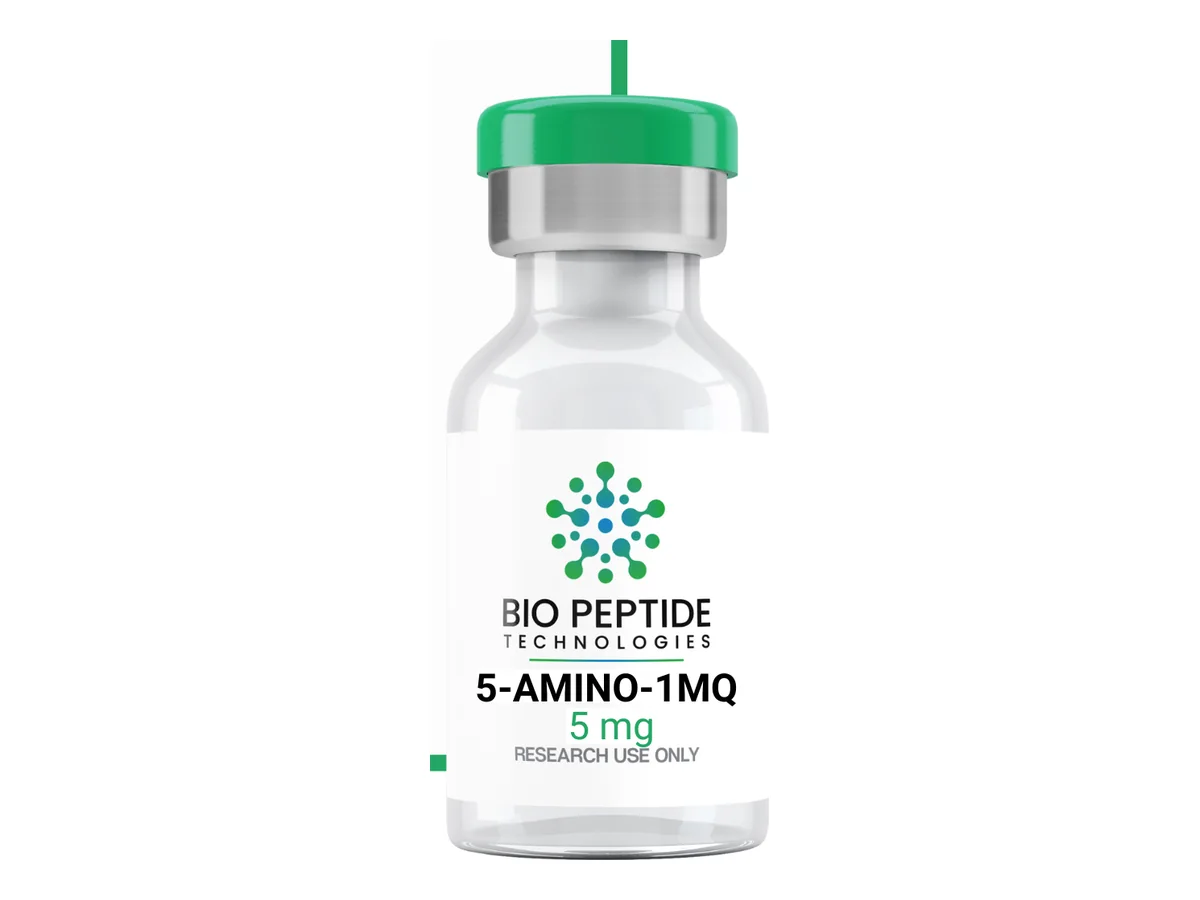
PubChem represents 5-amino-1-methylquinolinium as a positively charged heteroaromatic cation with formula C10H11N2+.[1] A separate PubChem record represents the iodide salt with formula C10H11IN2.[2] Those records illustrate why the counterion and formula-weight basis must be documented rather than inferred from “5-amino-1MQ.”
Biochemical evidenceA medicinal-chemistry study reported low-micromolar NNMT inhibition for quinolinium compounds and modeled interactions in the enzyme’s nicotinamide-binding region.[3]
Model evidenceLater work examined permeability models, murine adipocytes and a brief proof-of-concept mouse experiment.[4] These evidence types answer different questions.
What NNMT research measures
NNMT transfers a methyl group from S-adenosylmethionine to nicotinamide and related pyridine substrates. A 2021 review identifies 5-amino-1-methylquinolinium as a nicotinamide-site inhibitor while cautioning that incomplete selectivity and metabolic-stability information can limit interpretation of available probes.[5]
Potency values are assay-specific
The cited primary work reported an NNMT IC50 near 1.2 micromolar under its particular biochemical conditions.[3][4] An IC50 is not an intrinsic product specification: enzyme construct, substrate concentrations, detection method and analysis all affect the value. It cannot be treated as a potency guarantee for a seller lot.
Selectivity boundary: the published selectivity work covered a limited panel—not a comprehensive off-target assessment—and included an assay-interference limitation for one tested target.[4]
Keep cellular and animal findings in their models
The 2018 study reported changes in intracellular 1-methylnicotinamide, NAD+ and SAM in differentiated murine adipocytes, alongside short animal-model observations.[4] These findings do not establish human safety, efficacy, absorption or a consumer outcome.
Assay literacy for procurement
A validated LC-MS/MS method quantified the 5-amino-1-methylquinolinium analyte in rat plasma and urine.[6] Detecting the cation in a biological matrix does not identify a bulk material’s counterion and is not a substitute for raw-material identity, impurity or net-content testing.
Procurement essentials
- Confirm the full chemical name, counterion, molecular formula and formula-weight basis.
- Review whether the labeled quantity is stated on an as-is, salt, anhydrous or cation-equivalent basis.
- Request lot-matched identity and analytical documentation when available.
- Distinguish chromatographic purity, chemical identity, assay content, counterion confirmation and net mass.
- Keep published compound-level findings separate from seller and lot records.
Compare current research formats
The listings below show verified current catalog facts for qualified non-clinical procurement. PRX does not infer the supplied salt, purity, assay value or experimental performance from a title.
Sources
- PubChem: 5-amino-1-methylquinolinium, CID 950107
- PubChem: 5-amino-1-methylquinolinium iodide, CID 66522933
- Structure-Activity Relationship for Small Molecule Inhibitors of NNMT
- Selective and membrane-permeable small molecule inhibitors of NNMT
- Mechanisms and inhibitors of nicotinamide N-methyltransferase
- LC-MS/MS assay for 5-amino-1-methyl quinolinium in rat matrices