Research evidence guide
Ipamorelin evidence depends on the receptor, assay and material.
A cited identity and assay guide for the modified pentapeptide, GHSR terminology, direct receptor evidence and current non-clinical research formats.
Evidence snapshotIpamorelin is commonly represented as the modified pentapeptide Aib-His-D-2-Nal-D-Phe-Lys-NH2 and studied at the ghrelin-receptor pathway.[1][2]
Compare current prices and formats.
For qualified non-clinical research buyers. Not for human or veterinary use.
Disclosure: We may earn a commission from purchases made through our links.
Define the peptide and the target
PubChem represents ipamorelin as a synthetic modified pentapeptide commonly written Aib-His-D-2-Nal-D-Phe-Lys-NH2.[1] The relevant target terminology is ghrelin receptor or GHSR/GHS-R1a—not the growth hormone receptor and not the GHRH receptor.[2]
Foundational pharmacologyThe 1998 paper measured hormone secretion in primary rat pituitary cells and used antagonist profiling plus rat and swine experiments.[3]
Direct receptor evidenceA 2017 structure-activity study used a GHSR1a radiocompetition assay across peptidic secretagogues.[4]
What “selective” meant in the foundational study
The foundational study identified ipamorelin as a growth-hormone secretagogue and reported a rat-pituitary secretion response under specified assay conditions.[3] Its use of “selective” referred to the endocrine endpoints tested in rat and swine experiments; it was not a comprehensive assessment across human receptors, enzymes and ion channels.
Target boundary: direct receptor binding, functional signaling, pituitary secretion, downstream endocrine measurements and whole-animal phenotypes are separate evidence categories.
Direct binding is not the same as downstream efficacy
The 2017 radiocompetition work supports GHSR1a binding activity for intact peptidic secretagogues and shows that structural changes can alter receptor-assay activity.[4] Competitive displacement does not by itself establish full agonism, signaling bias or comprehensive off-target selectivity.
Assay values do not transfer across systems
Values from primary pituitary cells, isolated gastrointestinal tissue or whole-animal models cannot be compared as if they were universal constants. Species, tissue, endpoint, receptor density, controls and exposure history can materially change the observation.[3][5]
Material identity still needs lot evidence
Database records for neutral ipamorelin and acetate-associated forms show different formula representations.[1] A listing name or nominal vial quantity therefore does not establish counterion stoichiometry, intact mass, peptide-content basis, purity or stability.
Procurement essentials
- Confirm sequence notation, stereochemistry, terminal amide and declared chemical form.
- Request the intact-mass identity method and chromatographic method or trace when available.
- Review peptide-content basis, counterion identity, residual solvent and water information separately.
- Match every analytical record to the current lot and listing.
- Do not infer seller-lot quality from journal literature.
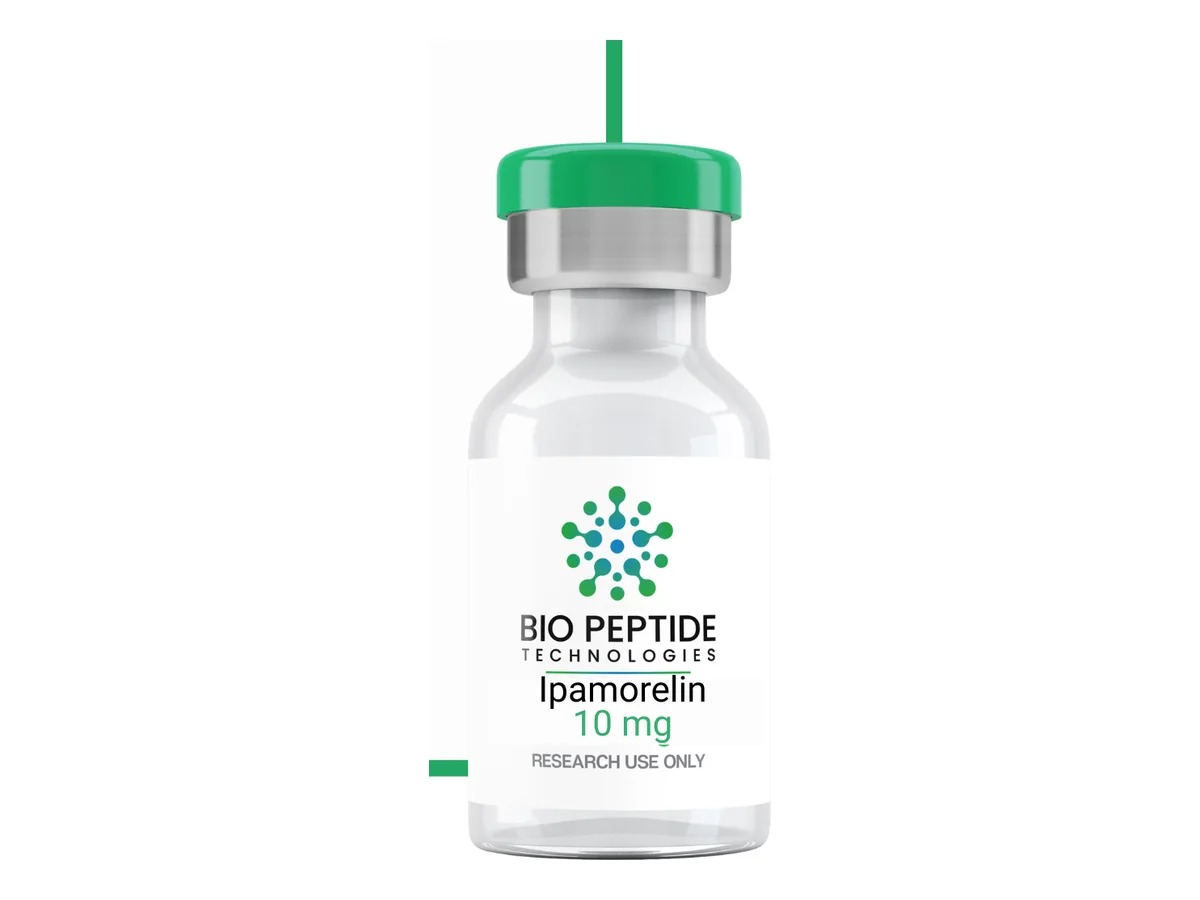
Compare current ipamorelin research formats
The listings below are catalog-size options for qualified non-clinical procurement. Their nominal quantities do not imply different pharmacology or an experimental application.