Research evidence guide
Kisspeptin-10 research: define the fragment before the assay.
A cited buyer guide to KP-10 identity, KISS1R terminology, receptor-assay evidence, model limitations and the current non-clinical research listing.
Evidence snapshotKisspeptin is a peptide family, not one interchangeable material. KP-54 and the shorter C-terminal fragments KP-14, KP-13 and KP-10 must remain distinct in records and interpretation.[1]
Compare current prices and formats.
For qualified non-clinical research buyers. Not for human or veterinary use.
Disclosure: We may earn a commission from purchases made through our links.
“Kisspeptin” does not identify one test material
The IUPHAR nomenclature review describes kisspeptin-54 as a C-terminally amidated 54-amino-acid peptide and identifies KP-14, KP-13 and KP-10 as shorter C-terminal fragments.[1] PubChem records Kisspeptin-10 separately as CID 25240297 with molecular formula C63H83N17O14.[2] These references help define the analyte; they do not authenticate a seller lot, counterion, quantity basis, purity, stability or experimental performance.
Nomenclature evidenceThe receptor once called GPR54 or AXOR12 is now officially named the kisspeptin receptor and encoded by KISS1R.[1]
Chemical database evidenceA structure record can anchor identity checks for KP-10, but it is not lot-specific analytical documentation.[2]
Match the fragment to the research question
The nomenclature review calls KP-10 the smallest active C-terminal fragment and reports that kisspeptin-receptor activation couples to Gq/11, phospholipase C and calcium mobilization.[1] That family-level summary does not make KP-10, KP-54, analogs or differently terminated materials interchangeable. Record fragment length, sequence, terminal chemistry, salt or counterion and quantity basis when those facts are supplied.
Identity boundary: a common receptor target does not establish material equivalence. Keep each result attached to the exact fragment or analog, receptor construct, cell system, endpoint and conditions studied.
Receptor activation and binding are different measurements
A 2001 receptor-deorphanization study expressed human AXOR12 in mammalian cells and reported high-potency agonism for KiSS-1-derived peptides with a shared C-terminal amidated motif.[3] This is engineered-cell functional evidence. It is not a direct lot test, a comprehensive selectivity panel or proof that every product labeled “kisspeptin” has equivalent activity.
Trafficking can change the calcium readout
A 2014 study used Chinese hamster ovary and GT1-7 cells expressing KISS1R. It reported a biphasic intracellular-calcium response and experiments implicating receptor internalization and recycling in the sustained phase.[4] This matters for assay design: exposure time, washout, receptor expression, trafficking inhibitors and the chosen analysis window may change the observed signal.
Analog studies should not be assigned to KP-10
A 2010 structure-modification study compared KP-10 analogs using KISS1R binding, ERK1/2 phosphorylation and mouse experiments.[5] One modified analog differed from KP-10 in receptor affinity and organism-level observations. The study demonstrates why an analog name, sequence change or stereochemical change must be recorded explicitly rather than folded into a generic “kisspeptin” evidence claim.
Genetic evidence defines receptor biology, not reagent performance
A 2003 study investigated GPR54 variants using human genetics, transfected COS-7-cell inositol-phosphate experiments and a knockout-mouse model.[6] Those evidence layers support the biological importance of the receptor pathway, but they do not establish the identity, quality, purity, stability or suitability of a commercial KP-10 material.
Procurement and assay checks for kisspeptin-10
- Confirm that the requested material is KP-10 rather than KP-54, KP-14, KP-13 or an analog.
- Record the supplied sequence, C-terminal amidation, stereochemistry, salt or counterion, quantity basis and formulation.
- Match current lot documentation to the exact listing and received lot; database and literature records are not lot evidence.
- Define the receptor species and construct, cell background, expression system, endpoint, exposure window, controls and acceptance criteria.
- Distinguish binding, calcium mobilization, ERK phosphorylation, receptor trafficking and organism-level endpoints in the study record.
- Verify current seller price, availability, shipment eligibility and institutional receiving requirements before ordering.
Review the current research format
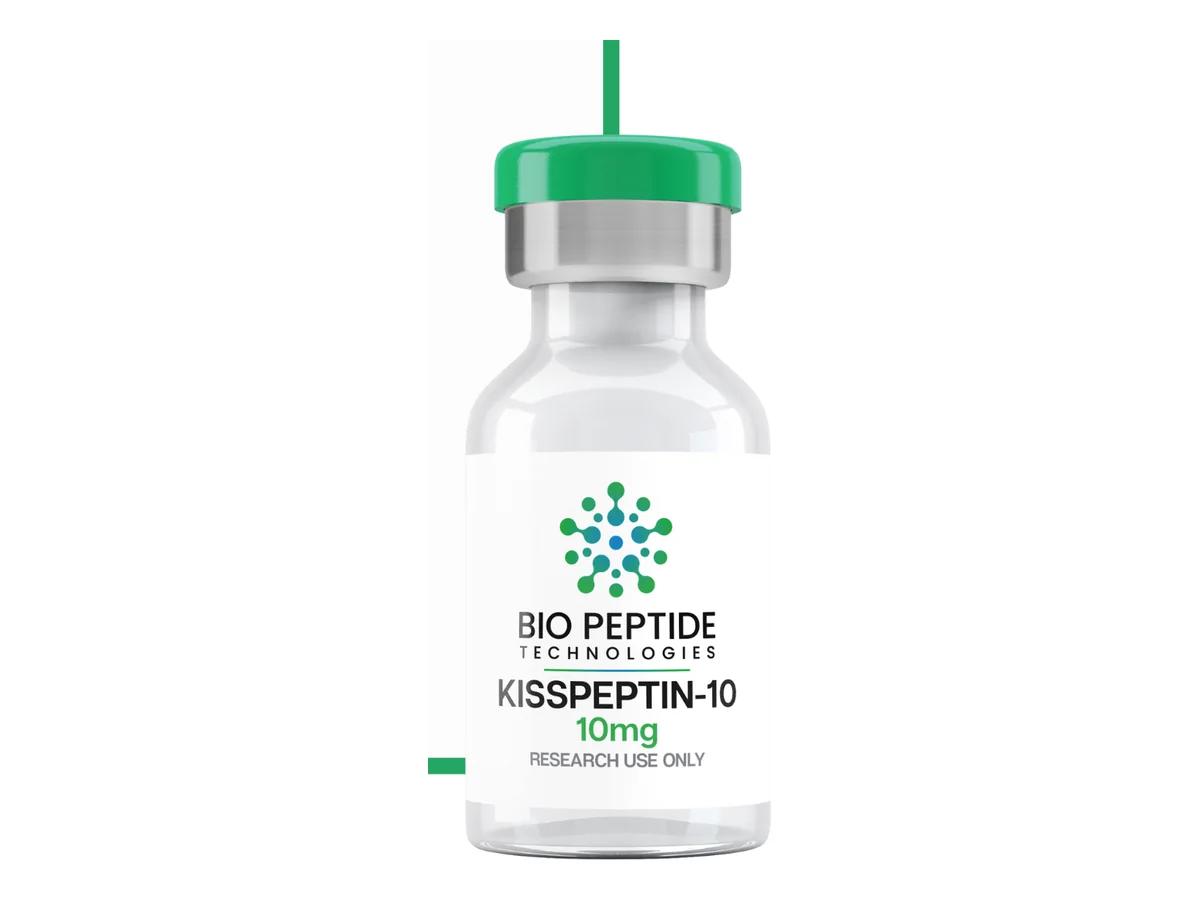
The card below uses current seller-catalog title, format, price and availability facts retrieved during generation. The literature above does not establish the identity, quality, purity, stability, performance or results of the seller product.
Sources
- IUPHAR LXXVII: Kisspeptin receptor nomenclature, distribution, and function — receptor nomenclature and peptide-fragment review.
- PubChem Compound Summary: Kisspeptin-10, CID 25240297 — structure-level chemical database record.
- AXOR12, a novel human G protein-coupled receptor, activated by the peptide KiSS-1 — mammalian-cell receptor-deorphanization study.
- Dynamic kisspeptin receptor trafficking modulates kisspeptin-mediated calcium signaling — engineered-cell calcium and trafficking study.
- A kisspeptin-10 analog with greater in vivo bioactivity than kisspeptin-10 — binding, cell-signaling and mouse-model analog comparison.
- The GPR54 gene as a regulator of puberty — human genetics, transfected-cell and knockout-mouse evidence.