Research evidence guide
KPV research peptide: evidence, 10mg price and procurement details.
Start with the Lys-Pro-Val identity and evidence limits, then review the current exact 10mg non-clinical research listing by format, price, availability, storage statement and documentation fields.
Evidence snapshotKPV commonly denotes the tripeptide Lys-Pro-Val and is also described as the C-terminal 11–13 fragment of alpha-melanocyte-stimulating hormone. A shared acronym does not authenticate a seller lot or establish experimental equivalence.[1][2]
Compare current prices and formats.
For qualified non-clinical research buyers. Not for human or veterinary use.
Choose a current listing, compare the available sizes, or open the exact seller page.
- Identity
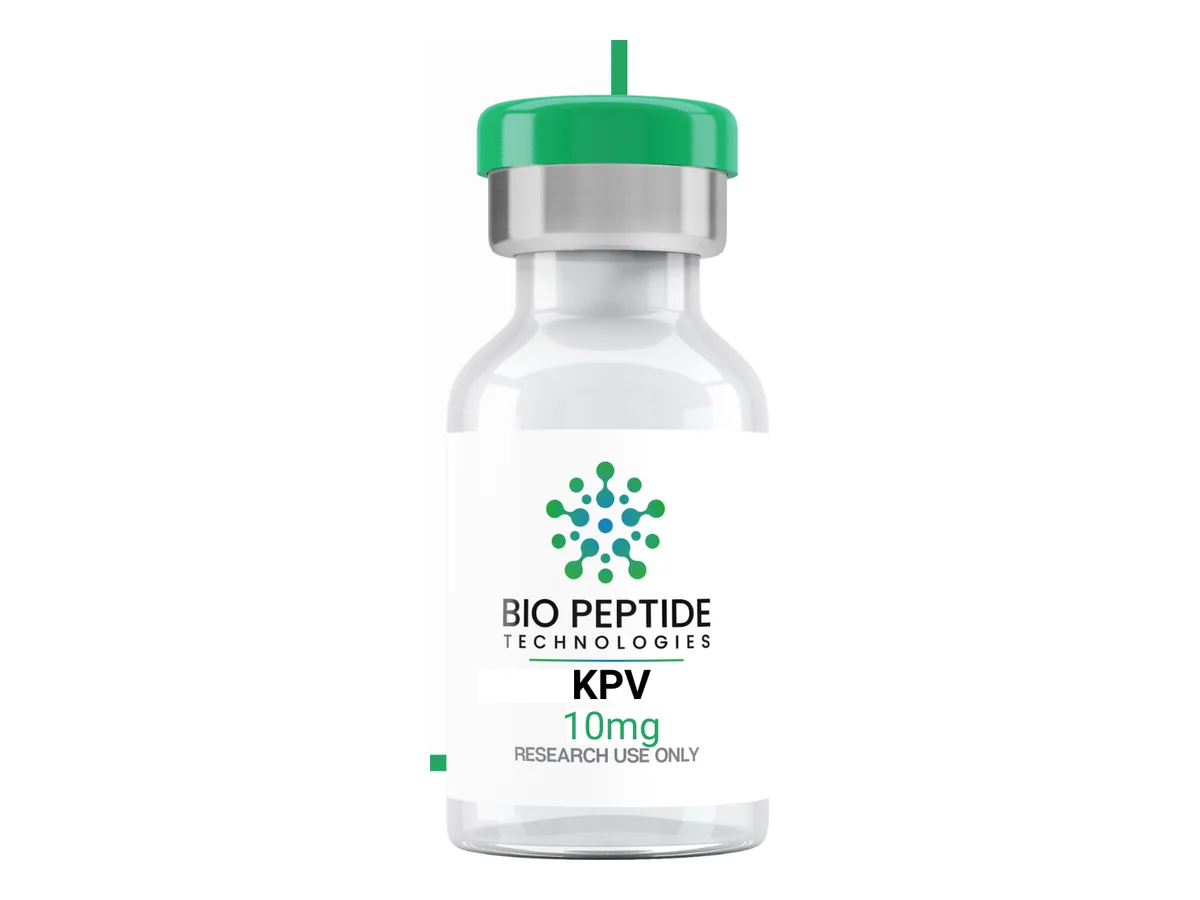
- KPV
- Labeled quantity
- 10mg
- Format
- Lyophilized Powder
- Seller storage statement
- Refrigerated storage recommended
Comparison limit: one exact KPV listing currently has an approved purchase route, so this page does not present a false same-identity price range. Match lot documentation to the received item; PRX has not independently verified a current public lot-specific certificate.
Disclosure: We may earn a commission from purchases made through our links.
Start with the three-residue identity
PubChem records MSH(11–13) as the tripeptide Lys-Pro-Val, with molecular formula C16H30N4O4 and a defined stereochemical structure.[1] The KPV acronym can also appear in modified peptides, conjugates and delivery systems, so sequence, termini, salt or counterion, and quantity basis should be established for the material actually under review.
Chemical database recordPubChem supplies a structure-level reference for Lys-Pro-Val.[1] It does not verify a seller lot, stated quantity, composition, purity, stability or experimental suitability.
Foundational model evidenceA 2003 study compared KPV with other melanocortin-related peptides in mouse peritonitis and macrophage experiments.[2] The results were specific to those models and endpoints.
Do not infer one universal mechanism
In the 2003 study, KPV reduced leukocyte accumulation in mouse inflammatory models but did not reproduce every macrophage or cyclic-AMP response measured for other melanocortin peptides.[2] The authors interpreted the KPV observations as mechanistically distinct from the core melanocortin peptides. That is a model-based interpretation—not comprehensive target identification or proof of a single pathway across systems.
Evidence boundary: a database structure, reporter assay, transporter experiment, mouse model and analytical separation method answer different questions. None establishes the identity, quality or performance of a current seller lot.
Cell experiments depend on system and endpoint
A 2008 paper studied KPV in human intestinal epithelial-cell lines and a T-cell line, using NF-kappaB, MAP-kinase and cytokine endpoints alongside peptide-transporter experiments.[3] A 2012 study used an immortalized human bronchial epithelial-cell model and reported effects on NF-kappaB-related signaling and chemokine secretion.[4] These are controlled cell-model observations; they do not establish organism-level outcomes, comprehensive selectivity or clinical utility.
Keep mouse findings in the mouse models
The 2008 intestinal study also examined two chemically induced mouse colitis models.[3] A separate 2008 paper evaluated KPV in two murine intestinal-inflammation models, including mice with nonfunctional MC1R signaling.[5] These experiments support research questions about model-specific inflammatory endpoints. They do not establish human outcomes, safety, efficacy or the properties of a commercial research listing.
Analytical methods are matrix-specific
A 2015 paper developed a reversed-phase HPLC method for KPV in aqueous solutions and skin homogenates and reported separation from stress-generated degradation products.[6] Its validation characteristics belong to that method, equipment, matrices and conditions. They are not a transferable purity claim, universal release method or certificate for a seller product.
Procurement checks for a KPV listing
- Confirm that “KPV” means Lys-Pro-Val rather than a modified, conjugated or longer sequence.
- Record the documented sequence, termini, salt or counterion, quantity basis and formulation when those facts are supplied.
- Match current lot documentation to the exact listing and received lot; do not substitute a paper or general database record for lot evidence.
- Define fit-for-purpose identity, assay and acceptance criteria in the laboratory's own protocol.
- Confirm current price, availability, shipping eligibility, fulfillment terms and institutional receiving controls before ordering.
Review the current research format
The listing below uses current seller-catalog price, format and availability facts retrieved during generation and is shown only for qualified non-clinical research procurement. The literature above is not evidence of the identity, quality, purity, stability, performance or results of the seller product.
Sources
- PubChem Compound Summary: MSH (11–13), CID 125672 — chemical database record for Lys-Pro-Val.
- Dissection of the anti-inflammatory effect of the core and C-terminal (KPV) alpha-melanocyte-stimulating hormone peptides — mouse peritonitis and macrophage-model comparison.
- PepT1-mediated tripeptide KPV uptake reduces intestinal inflammation — epithelial-cell, T-cell, transporter and mouse-model study.
- Inhibition of cellular and systemic inflammation cues in human bronchial epithelial cells by melanocortin-related peptides — immortalized epithelial-cell signaling study.
- Melanocortin-derived tripeptide KPV has anti-inflammatory potential in murine models of inflammatory bowel disease — two mouse-model study.
- Stability-indicating HPLC assay for lysine-proline-valine (KPV) in aqueous solutions and skin homogenates — matrix-specific analytical-method study.