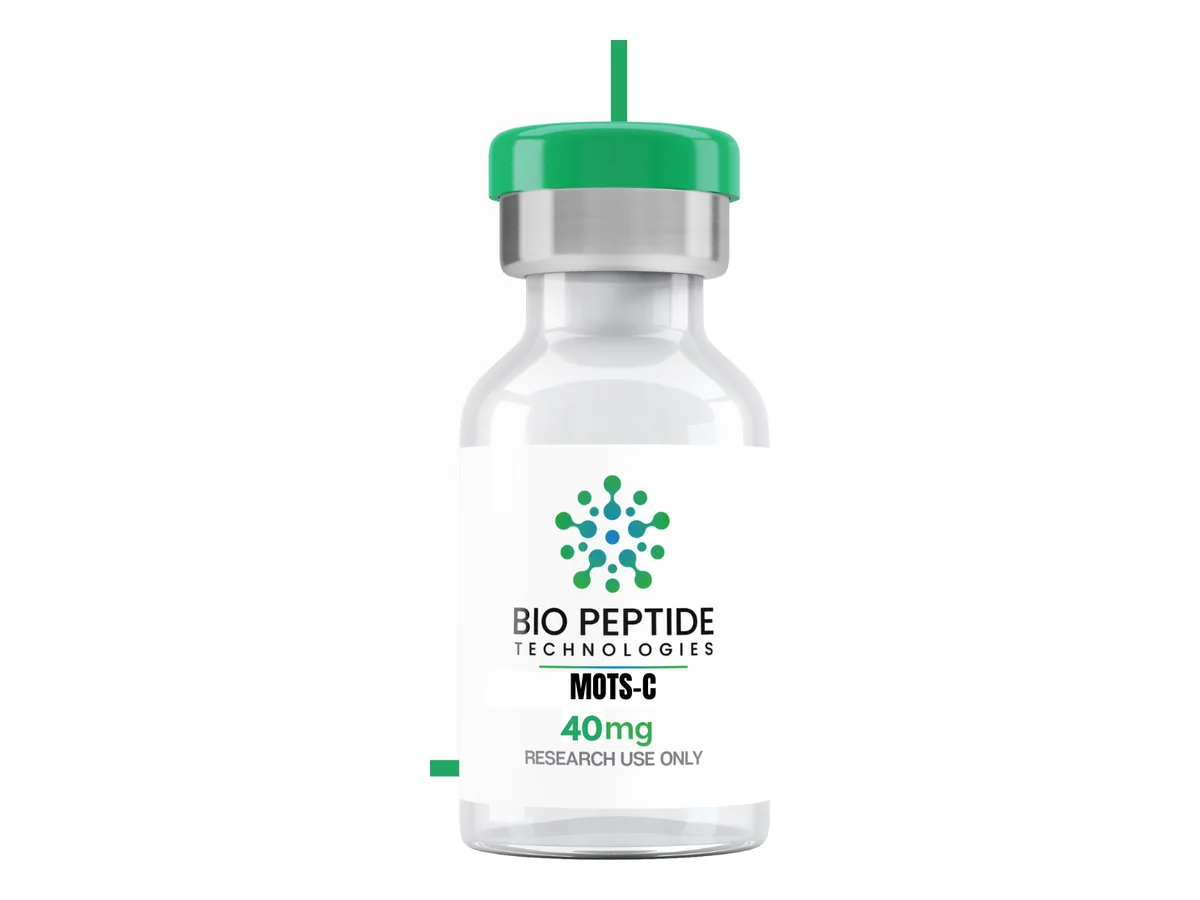
Research evidence guide
MOTS-c research: separate mechanism, model and material.
A cited evidence map for mitochondrial signaling research, with clear distinctions between cellular studies, mouse interventions and human observational measurements.
Evidence snapshotMOTS-c was described as a 16-amino-acid mitochondrial-derived peptide. Much of the intervention record is cellular or preclinical.[1]
Compare current prices and formats.
For qualified non-clinical research buyers. Not for human or veterinary use.
Disclosure: We may earn a commission from purchases made through our links.

A mitochondrial-derived research target
A 2015 primary study described MOTS-c as a 16-amino-acid peptide encoded within mitochondrial 12S rRNA and reported findings involving the folate cycle, purine biosynthesis and AMPK activation in experimental systems.[1]
Cellular evidenceResearch has examined stress-dependent nuclear translocation, AMPK-dependent gene regulation and interactions involving antioxidant-response elements.[2]
Organism-level evidenceIntervention findings reported in the foundational study were obtained in mouse models and cannot establish corresponding human outcomes.[1]
Mechanism is not a clinical outcome
A 2018 mechanistic study reported that MOTS-c translocated to the nucleus after metabolic stress and regulated nuclear gene expression in an AMPK-dependent manner.[2] Those observations depend on experimental conditions and do not establish clinical safety, efficacy or an approved use.
Evidence boundary: a signaling observation, an animal intervention and an endogenous human measurement answer different questions. None verifies a seller product’s identity, purity, stability or experimental suitability.
How to interpret the human observations
A 2021 translational study reported exercise-associated changes in endogenous MOTS-c expression in human skeletal muscle and circulation, alongside cell experiments and mouse interventions.[3] The human component was observational and was not a controlled trial of an externally supplied MOTS-c product.
Procurement essentials
- Confirm the labeled sequence, molecular identity, quantity and format.
- Determine whether the planned work involves reference MOTS-c or a sequence variant.
- Request current lot documentation and review the stated analytical methods.
- Record storage requirements, lot identifiers, acceptance criteria and receipt condition.
- Do not infer seller-lot properties from compound-level literature.
Compare current MOTS-c research formats
The listings below are presented only for qualified non-clinical research procurement. Inclusion is not independent verification of a lot or a representation that published findings apply to a seller product.
Sources
- The mitochondrial-derived peptide MOTS-c promotes metabolic homeostasis and reduces obesity and insulin resistance
- MOTS-c Translocates to the Nucleus to Regulate Nuclear Gene Expression in Response to Metabolic Stress
- MOTS-c is an exercise-induced mitochondrial-encoded regulator of age-dependent physical decline and muscle homeostasis