Research evidence guide
Pinealon research is preliminary, model-specific and identity-sensitive.
A cited guide to Glu-Asp-Arg identity, biophysical and cell-model evidence, exploratory mouse findings and current non-clinical research formats.
Evidence snapshotPinealon is associated with the tripeptide sequence Glu-Asp-Arg, or EDR. The evidence record is small, model-heavy and limited in independent replication.[1]
Compare current prices and formats.
For qualified non-clinical research buyers. Not for human or veterinary use.
Disclosure: We may earn a commission from purchases made through our links.
Identity at a glance
PubChem maps Pinealon and Glu-Asp-Arg to the all-L tripeptide represented by CID 10273502.[1] “EDR” is a short sequence acronym that can be ambiguous outside this context, and the parent/free-peptide record does not authenticate a seller lot or define an unspecified salt form.
Biophysical evidenceOne in-vitro study reported Glu-Asp-Arg interaction with DNA under defined solution conditions and found that the ionic environment affected the measured interaction.[2]
Cell-model evidenceFluorescence-labeled Pinealon was observed in cultured HeLa-cell compartments, but the label itself may affect uptake and behavior.[3]
Physical interaction is not an organism-level mechanism
The biophysical work used spectroscopy, NMR, viscosimetry and molecular dynamics to examine peptide–DNA interaction.[2] Binding under controlled solution conditions does not establish gene regulation, cellular uptake, biodistribution or a clinical mechanism.
Translation boundary: cell-free interaction, fluorescent-cell uptake, neuronal morphology and an animal-model endpoint each require separate interpretation. None verifies a current seller lot.
What the cell studies can—and cannot—show
The HeLa-cell study combined fluorescence imaging with cell-free nucleic-acid assays.[3] It does not show that intact unlabeled Pinealon reaches neurons or crosses the blood–brain barrier. Other cell studies report oxidative-stress and morphology endpoints, but they do not establish cognition, disease modification or anti-aging effects.[4]
Exploratory mouse evidence
A 2021 study used 5xFAD-related mouse models and reported an EDR-associated dendritic-spine morphology endpoint.[5] The authors stated that the exact mechanism was unknown, and the clearer electrophysiological trend in the paper was associated with a different peptide. The study does not demonstrate a Pinealon-specific cognitive benefit.
Recent human-derived cell evidence
A 2024 study used induced neurons derived from three older female fibroblast donors. EDR did not affect mitochondrial activity, lysosomal activity or p16, and its reported oxidative-DNA-damage result narrowly missed conventional statistical significance.[6] Human-derived cells are not a human clinical study.
Procurement essentials
- Confirm Glu-Asp-Arg sequence, stereochemistry, termini and declared salt form.
- Review intact-mass identity and chromatographic documentation separately.
- Determine whether nominal quantity means total material or peptide-content basis.
- Match documentation to the current lot and record test dates and methods.
- Do not infer sterility, endotoxin, stability or residual-solvent status from HPLC alone.
Compare current Pinealon research formats
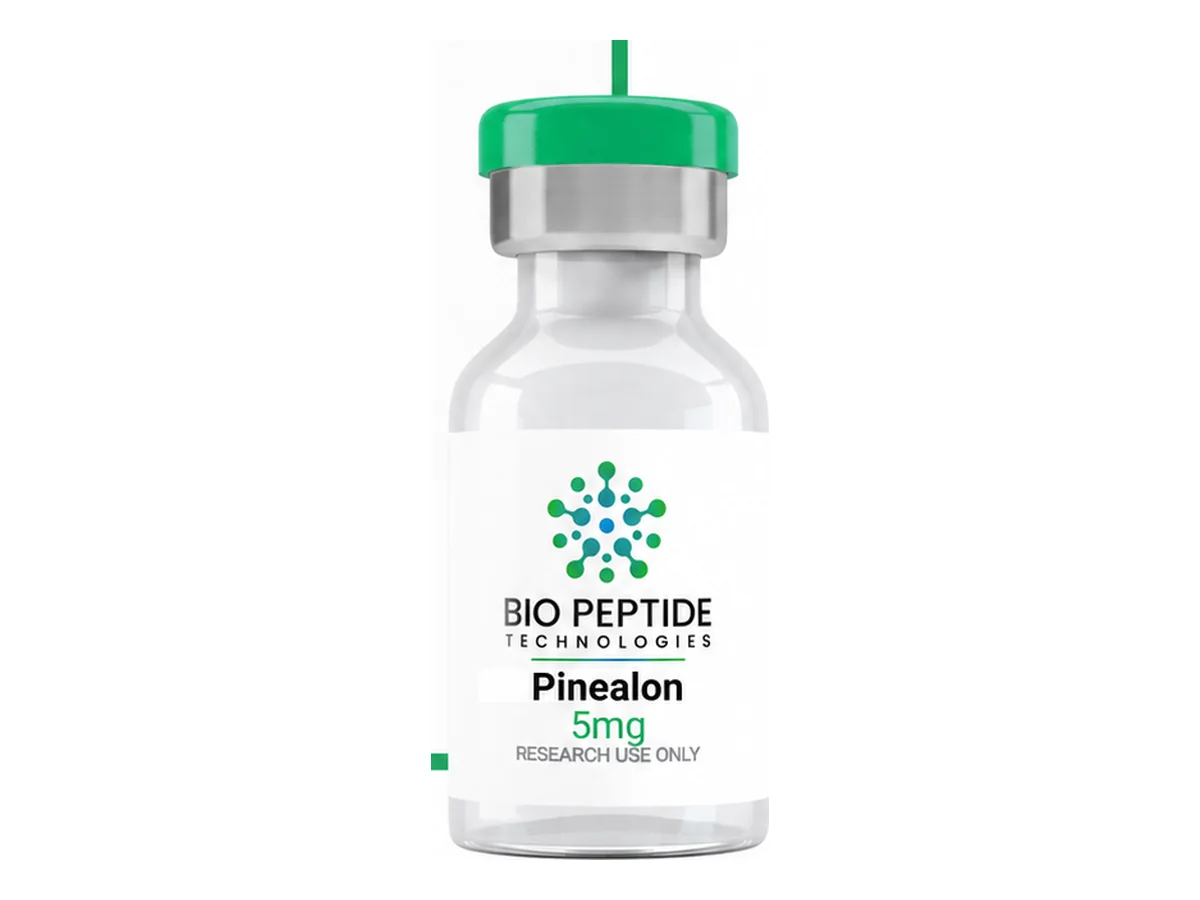
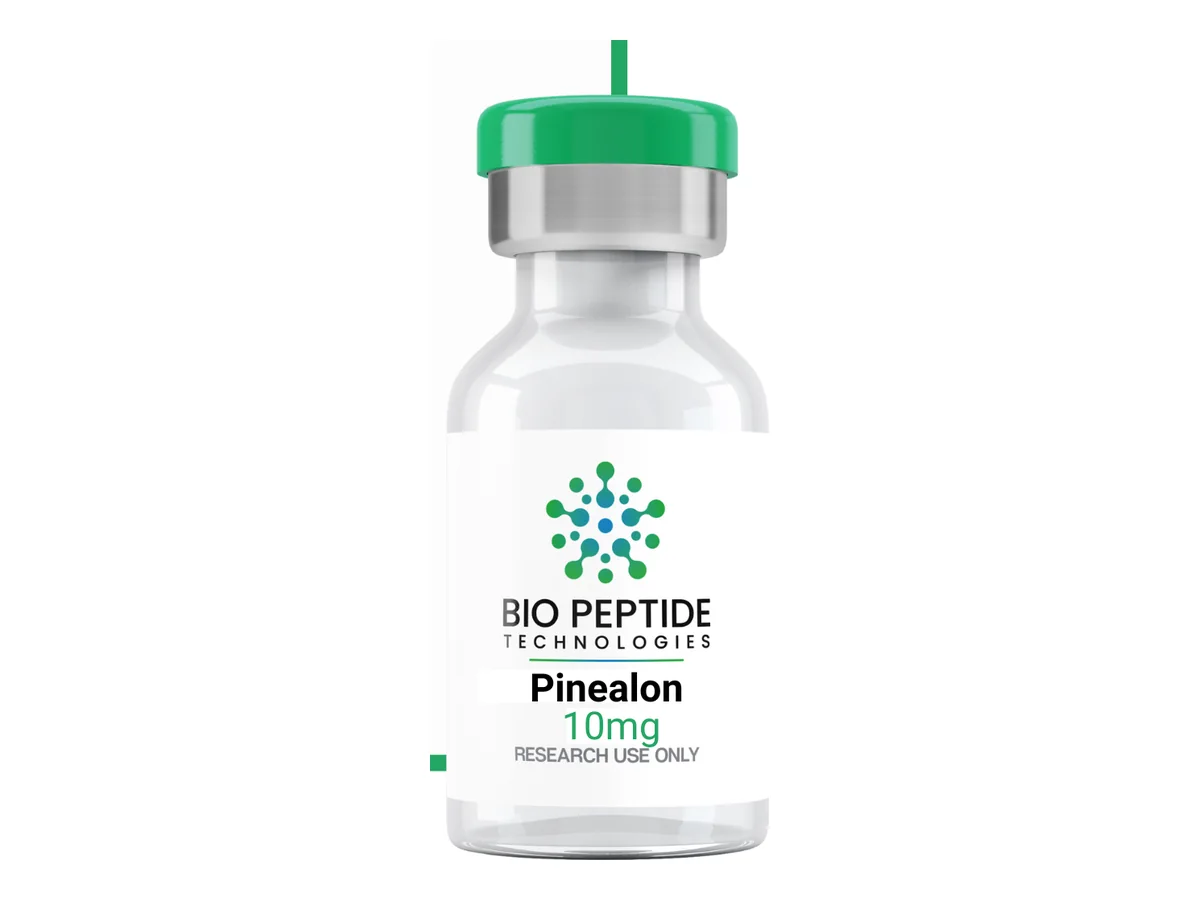
The current listings below are presented only for qualified non-clinical procurement. Nominal 5mg and 10mg quantities are catalog attributes—not doses or evidence of comparative performance.
Sources
- PubChem: Glu-Asp-Arg / Pinealon, CID 10273502
- Role of Mono- and Divalent Ions in Peptide Glu-Asp-Arg-DNA Interaction
- Penetration of short fluorescence-labeled peptides into HeLa cells
- Pinealon cellular oxidative-stress experiments
- Tripeptides in a 5xFAD mouse model
- Short peptides in fibroblast-derived induced neurons