Research evidence guide
Thymosin alpha-1 research: keep identity, model and endpoint attached.
A cited buyer guide to the 28-residue peptide, solution-structure evidence, dendritic-cell and lymphocyte models, assay limitations and the current non-clinical research listing.
Evidence snapshotThymosin alpha-1, also called thymalfasin in chemical databases, is represented as a 28-residue peptide. Structure, dendritic-cell and transcription studies use different systems and cannot be pooled as one product-performance claim.[1][2]
Compare current prices and formats.
For qualified non-clinical research buyers. Not for human or veterinary use.
Disclosure: We may earn a commission from purchases made through our links.
Start with the exact peptide record
A PubChem record maps thymalfasin to CID 16130571 and reports molecular formula C129H215N33O55 and molecular weight 3108.3.[1] An NMR study describes human thymosin alpha-1 as a 28-residue peptide.[2] These references can anchor an identity review, but they do not authenticate a seller lot or establish its purity, stability, quantity basis or experimental performance.
Chemical database evidencePubChem provides a structure-level record for thymalfasin; a database identity is not batch-specific analytical documentation.[1]
Solution-structure evidenceThe NMR model was measured in 40% trifluoroethanol and 60% water, so the reported conformation is tied to that solvent system.[2]
Solution conditions are part of the result
The 800 MHz NMR study reported a structured conformation with an alpha-helical region spanning residues 14–26 and turn features in the N-terminal region.[2] It used restrained molecular dynamics with an explicit solvent model corresponding to the experimental solvent mixture. The result should not be generalized automatically to other buffers, concentrations, temperatures, surfaces or biological matrices.
Evidence boundary: chemical-database identity, solution conformation, receptor-pathway inference, cell-surface markers, cytokine measurements and transcription profiles answer different questions. None verifies the current seller material.
Dendritic-cell findings depend on the stimulus and species
A 2004 study used fungus-pulsed dendritic cells and mouse experiments, reporting pathway and cytokine observations involving p38 MAPK, NF-κB and MyD88-dependent signaling.[3] A separate study used human and murine dendritic cells and examined IDO-related tryptophan catabolism, cytokines and T-cell readouts.[4] Species, cell preparation, stimulus and endpoint must remain attached to each result.
Human monocyte-derived cells showed context-dependent responses
A 2015 in-vitro study exposed human monocyte-derived dendritic cells to viral or bacterial Toll-like-receptor agonists and infection models.[5] The reported direction of measured markers differed across the viral and bacterial conditions. This is a useful warning against treating “immune modulation” as one universal, assay-independent effect.
Transcription profiling is hypothesis-generating
A human peripheral-blood-mononuclear-cell experiment measured a panel of 8,300 genes after in-vitro treatment and reported a broad set of transcriptional changes.[6] A transcription profile does not by itself establish protein abundance, pathway causality, functional selectivity or organism-level outcomes. Record exposure conditions, donor characteristics, normalization and validation methods before comparing data.
Procurement and assay checks for thymosin alpha-1
- Confirm the requested material name, 28-residue identity, sequence, N-terminal state, terminal chemistry, salt or counterion and quantity basis when supplied.
- Match current lot documentation to the exact listing and received lot; literature and database records are not lot evidence.
- Record solvent, buffer, pH, temperature, concentration and surface-contact conditions for structural or stability work.
- For cellular studies, define species, donor or cell line, differentiation protocol, stimulus, exposure window, controls and endpoint.
- Do not merge cytokine, surface-marker, transcription, pathway and organism-level observations into one activity claim.
- Verify current seller price, availability, shipment eligibility and institutional receiving requirements before ordering.
Review the current research format
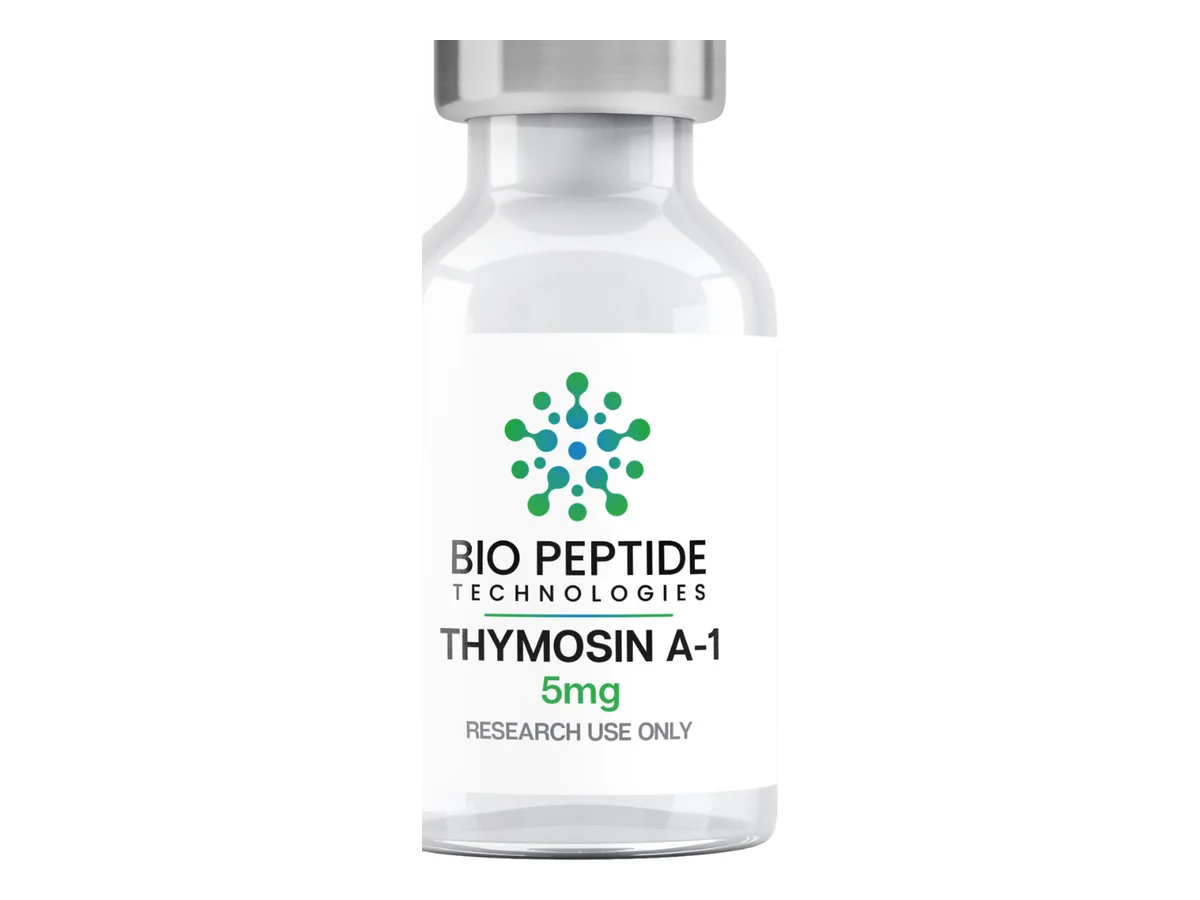
The card below uses current seller-catalog title, format, price and availability facts retrieved during generation. The literature above does not establish the identity, quality, purity, stability, performance or results of the seller product.
Sources
- PubChem Compound Summary: Thymalfasin, CID 16130571 — chemical database record.
- NMR structure of human thymosin alpha-1 — 800 MHz NMR and restrained molecular-dynamics study in a defined TFE/water solvent system.
- Thymosin alpha 1 activates dendritic cells for antifungal Th1 resistance through toll-like receptor signaling — dendritic-cell and mouse-model study.
- Thymosin alpha1 activates dendritic cell tryptophan catabolism and establishes a regulatory environment for balance of inflammation and tolerance — human/murine dendritic-cell and transfer-model study.
- Dual effect of Thymosin α1 on human monocyte-derived dendritic cell in vitro stimulated with viral and bacterial toll-like receptor agonists — primary human-cell in-vitro study.
- Transcription profile of human lymphocytes following in vitro treatment with thymosin alpha-1 — PBMC transcription-panel study.